A 3-step systemic approach for a long-term follow-up of the countries

Historically , to provide long-term support to countries, the GI WACAF Project adopts a three-step approach to support countries in developing an effective and sustainable national preparedness and response system.

These steps focus on the essential legal foundations and contingency plans, as well as cross functional aspects :

  • Step 1 - Establishing the Framework

    A strong legislative and regulatory framework forms the foundation of any national system.
    This includes the ratification and implementation of international conventions, the development of national laws and regulations, and the establishment of clear institutional responsibilities, as well as regional and transboundary agreements.

  • Step 2 - Implementing the Framework

    Once established, the legislative framework must be effectively implemented through policies, systems and operational capacities.

    Step 2.1 - Developing Policies and Tools

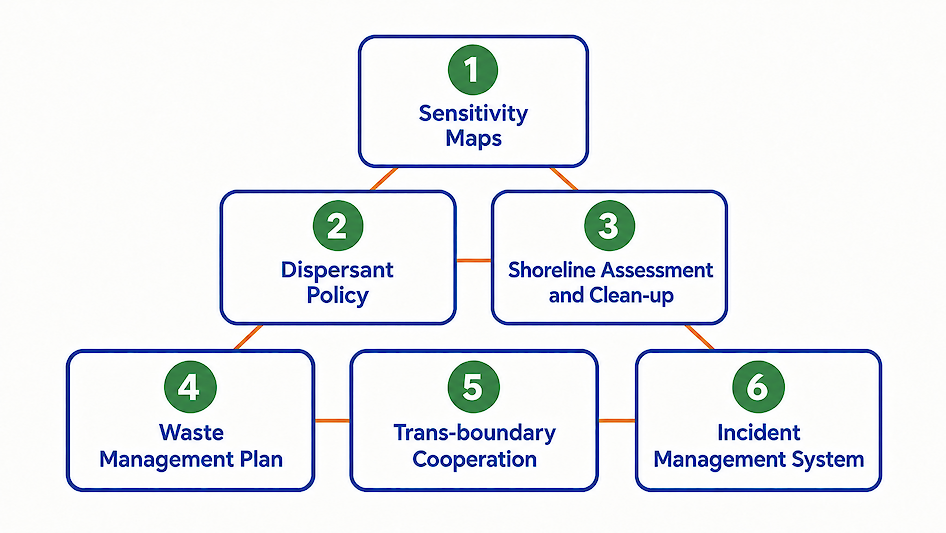
    Countries are supported in developing key policies and planning tools, such as:

    • National Oil Spill Contingency Plans
    • Dispersant use policies
    • Waste management strategies
    • Shoreline clean-up plans
    • Sensitivity mapping and response tools
    • Incident management systems
    Step 2.2 - Building Operational Capacity

    Countries are encouraged to establish operational systems and resources required for effective incident management and spill response, in line with national policies and legislation.

  • Step 3 - Strengthening Cooperation

    Preparedness systems are reinforced through cross-cutting elements such as regional cooperation, transboundary coordination and procedures facilitating international assistance in the event of a major spill.

By contributing to the implementation of international agreements GI WACAF is supporting both governments and operators reach high standards in their contingency planning and thus reduce environmental consequences in the event of a major oil spill. This benefits the industries as well as the governments. While countries see their level of preparedness and response to oil spill enhanced, industry benefits from the improvement of the legal and institutional framework that reduces regulatory uncertainty and ease the dialogue with relevant authorities.

Monitoring Progress and Measuring Impact

Since its launch, the GI WACAF Project has developed a structured approach to monitor and assess the evolution of oil spill preparedness and response capacities across partner countries.

Building on initial data collected in 2006, the Project has continuously gathered and updated information provided by national authorities and industry representatives. This has enabled the tracking of progress over time and the identification of remaining gaps, in line with the requirements of the International Convention on Oil Pollution Preparedness, Response and Co-operation (OPRC), 1990. Today, the Project relies on a comprehensive set of indicators covering both institutional and operational aspects of preparedness systems including:

  • Designation of authority


    The country has in place a designated national authority to deal with oil spill related issues.

  • Legislation

    The country has ratified the OPRC 90 Convention, and successfully transposed it into its national legal and regulatory framework.

  • National Oil Spill Contingency Plan

    The country has an approved NSCP.

  • Regional agreement

    The country has in place either a regional, sub-regional, or bi-lateral agreement relating to oil spill response cooperation.

  • Training and Exercise

    The country has undertaken a national level oil spill training and exercise event.

  • National Resources

    The country has equipment and resources to adequately address oil spill risks.

In addition, more detailed indicators provide insight into the operational maturity of national systems, including:

This approach allows GI WACAF to move beyond basic capacity assessments and towards a more qualitative understanding of preparedness, reflecting the increasing complexity and maturity of response systems across the region.

It also enables the Project to tailor its activities to the specific needs of each country, ensuring targeted support and continuous improvement at both national and regional levels.